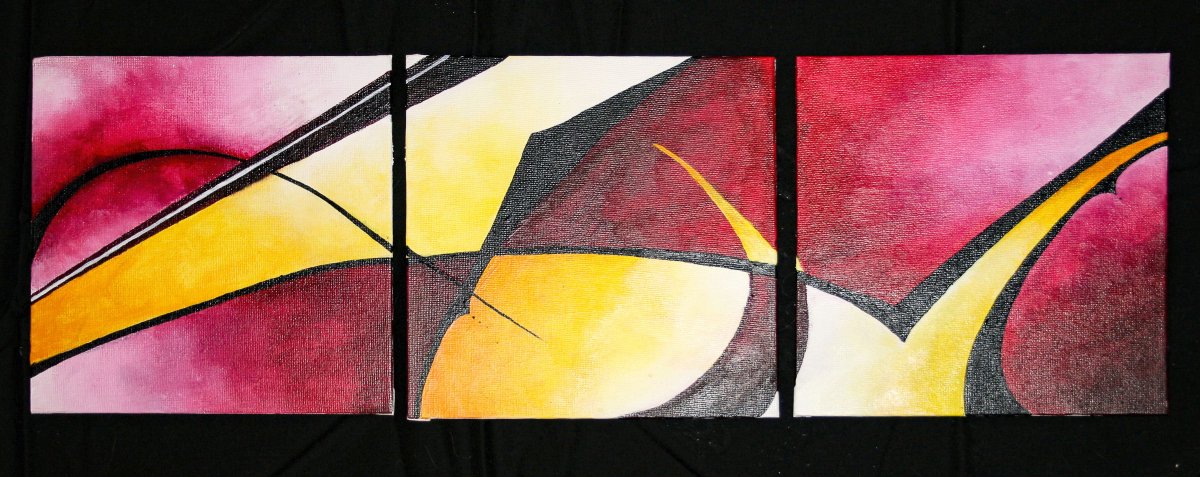
Happy Code is driven by emotion
But art is not a handicraft;
It is the transmission of feeling the artist has experienced.
My wife once painted something
that, in a way, became
the starting point for the Happy Code idea.
She wasn’t trying to say anything.
No concept.
No message.
Just a blank canvas
and a brush that kept saying yes.
Shape, then another.
A colour that felt right.
Then the next stroke,
exactly where it wanted to be.
It was pure instinct made visible.
Later she gave it to my father.
He loved it.
But he’s a mathematician.
So he did what mathematicians do:
“Why this colour?”
“Why this shape?”
“How did you decide?”
She shrugged.
“I didn’t decide.
I just did it.”
That answer bothered him more than anything.
Because if something is good,
there must be a reason.
A rule.
A proof hiding somewhere.
As developers, we really like
to talk about code in this way as well.
But sometimes the reason is:
it just felt right.
That’s how code feels when it’s alive.
You can explain it afterwards.
You can name the pattern.
You can write a tidy story
about trade-offs and best practices.
And sometimes that story is true.
But sometimes it’s just a label
you put on a decision you made with your gut.
Because it felt clean.
Because it felt simple.
Because the next line practically wrote itself.
Happy Code works exactly like that.
It is driven by emotion.
Not random.
Not magical.
Just human.
You write the code that feels right
at that moment.
You keep what fits.
You delete what doesn’t.
And you don’t owe anyone a philosophy
for every brush stroke.
If it runs, if it reads, if it helps –
that’s the reason.
Stop arguing with the picture.